
Why the wood choice matters in Texas
When it comes to building a beautiful, long-lasting wood fence, the materials you choose are going to battle against triple-digit Texas heat, severe spring storms, and high humidity. While cedar is the undisputed gold standard for surviving these extremes, the fencing market is flooded with different species and cheaper alternatives.
Understanding the difference between Western Red Cedar, Japanese Cedar, and standard Pine — and knowing how some contractors use these differences to pad their own pockets — can save you thousands of dollars and years of frustration.
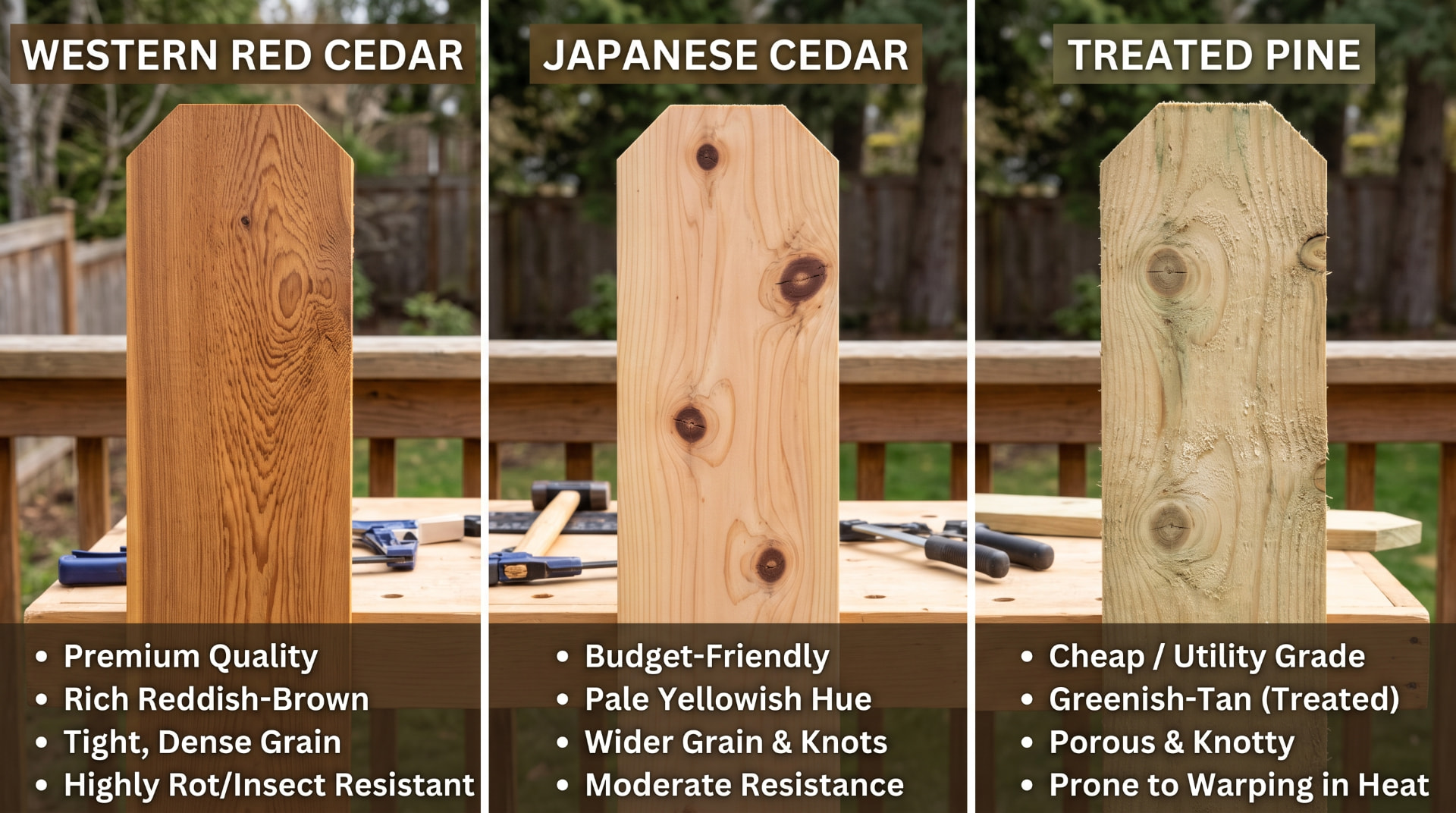
Western Red Cedar: the true gold standard
When most people picture a classic, premium cedar fence, they are picturing Western Red Cedar (WRC). Sourced primarily from the Pacific Northwest and Canada, WRC grows slowly in cool, wet climates.
- Durability and density: because it grows slowly, WRC has a tight grain pattern and high density, making it incredibly structurally sound and resistant to warping or shrinking in the Texas sun.
- Natural defenses: WRC is packed with natural tannins and oils that act as a built-in defense system against rot, decay, and termites.
- Appearance: it boasts a rich, varied color palette ranging from light honey to deep, dark reddish-browns. Over time, if left unstained, it weathers to a beautiful, classic silvery-gray.
Japanese Cedar (Sugi): the mid-tier compromise
Japanese Cedar, often sold under the name Sugi, is a fast-growing plantation wood. Because it grows much faster than Western Red Cedar, its cellular structure is entirely different.
- Lower density: the fast growth cycle means Japanese Cedar has a wider grain and lower density. It is significantly lighter and softer than WRC, making it more prone to denting, dinging, and warping under harsh weather conditions.
- Reduced oil content: while it still contains some natural oils, it lacks the heavy tannin concentration of Western Red Cedar, meaning its natural lifespan against rot and insects is shorter.
- Appearance: Japanese Cedar is generally much paler and has a more uniform, yellowish appearance. It lacks the rich, dark hues of WRC.
Treated pine: the budget option with a catch
Pressure-treated pine is the most budget-friendly fencing material upfront, but it comes with severe limitations — especially in Texas. While treated pine is excellent for the hidden structural posts and horizontal rails because of its raw strength, using pine for the fence pickets themselves is often a mistake.
- The Texas heat factor: pine is a highly porous wood that absorbs and releases moisture rapidly. When exposed to the baking Texas sun and wild humidity shifts, pine pickets will quickly warp, twist, cup, and shrink. It is common to see large gaps form between pine pickets within the first year.
- High maintenance: to keep a pine fence looking decent and to fight off decay, it requires relentless maintenance. You will need to clean, seal, and stain a pine fence far more frequently than cedar just to keep it structurally intact.
- The look: pine starts out with a green or yellowish tint from the pressure-treating chemicals. Because it twists as it dries, a pine fence rarely maintains the straight, clean, uniform lines required for a high-end privacy fence.
The contractor “bait and switch”
Pine and Japanese Cedar are not inherently bad woods — they just serve different purposes. The problem arises when contractors use them deceptively to cut corners in a few specific ways:
- 1. The vague “cedar” quote. A contractor hands you a quote that simply says “Cedar Privacy Fence” and charges a premium price that aligns with Western Red Cedar. When installation day comes, they drop off a load of cheap Japanese Cedar, pocket the massive difference in material costs, and you get a fence that weathers prematurely.
- 2. The “stained pine” illusion. Some contractors quote a “custom stained wood fence” and use cheap pine pickets covered in a dark cedar-toned stain. Once that stain fades under the Texas sun, the twisting and warping of the pine quickly reveal the inferior wood underneath.
- 3. The thickness trick. Even if a contractor uses Western Red Cedar, they might try to cut costs with inferior cuts. A standard, durable privacy fence picket should be a full 3/4-inch thick. Some contractors will use 5/8-inch or even 1/2-inch thick pickets, and these paper-thin boards will cup and split rapidly.
- 4. Sapwood vs. heartwood. The most durable part of the cedar tree is the heartwood, the darker inner core. The sapwood, the lighter outer layer, is much softer and highly susceptible to rot. Bad contractors buy heavily discounted, low-grade cedar that is mostly sapwood. It might look nice on day one, but it will rot at the base within a few short years.
How to protect your investment
You don't have to be a lumber expert to protect yourself from these shortcuts. Just follow these simple rules when hiring a fence contractor:
- Get it in writing. Never accept a quote that just says “Cedar” or “Wood.” Demand that the contract specifies the exact species — for example, “Standard and Better Western Red Cedar.”
- Specify the specs. Your contract should explicitly state the thickness of the pickets (insist on 3/4-inch or 7/8-inch) and the grade of the wood.
- Ask about the rails and posts. A great picket means nothing if the structural frame is cheap. Ensure your contractor is using heavy-duty galvanized steel posts (crucial for high Texas winds) and thick, high-grade cedar 2x4s for the horizontal runners.
The bottom line
Your fence is a major investment in your home's security, privacy, and curb appeal. By knowing exactly what materials you are paying for, you can ensure your yard looks pristine for decades to come.